02 · The label
Phenology in free text
Did the collector already write down what the model is trying to infer, and can you trust the tag?
- Status
- Running on the harvest now
- Field
- Thin — some prior work
- Who wants it
- Anyone training a phenology model, including us — and any institution that wants its phenology tags to be trustworthy.
Why it matters
Collectors routinely wrote in fruit, fl., sterile — an expert label generated in the field, sitting in pixels. But a keyword scan that fires on flower-bearing organs tags a sterile sheet as flowering. Running OCR on the parser's label region and mining only assertive phrases separates the real claim from the morphology note. On this harvest, most keyword tags checked this way turned out to be the descriptive trap, and OCR recovered real assertions the metadata never carried.
What it needs
The sheet parser (to find the label) and OCR (to read it). Both run now. Handwriting is the ceiling; printed and typed labels read cleanly.
State of the art
The keyword approach is common and quietly wrong. Reading the image and refusing descriptive text is not routinely done.
The working set
225 sheets in the harvest match this head’s starting slice
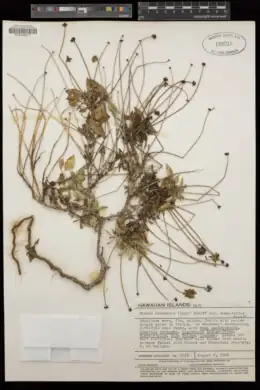 fruiting
Bidens mauiensis
Asteraceae · RSA · 1966
Hawaiian Islands
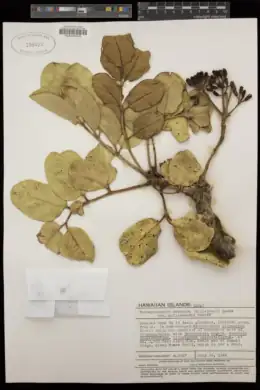 fruiting
Tetraplasandra meiandra
Araliaceae · RSA · 1966
Hawaiian Islands
 fruiting
Bidens mauiensis
Asteraceae · RSA · 1966
Hawaiian Islands
 fruiting
Bidens macrocarpa
Asteraceae · RSA · 1964
Hawaiian Islands
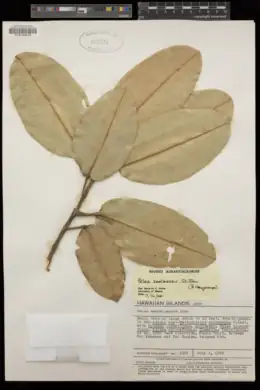 fruiting
Pelea kaalaensis
Rutaceae · RSA · 1966
Hawaiian Islands
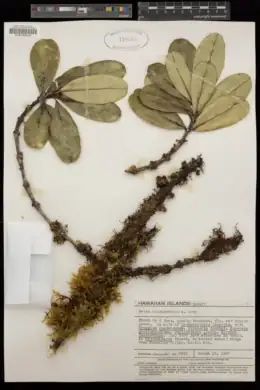 fruiting
Pelea clusiaefolia
Rutaceae · RSA · 1967
Hawaiian Islands
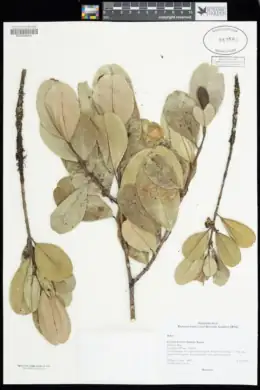 fruiting
Pelea
Rutaceae · RSA · 1974
Hawaiian Islands
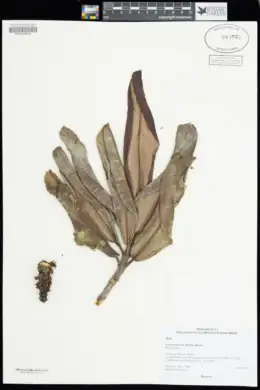 flowering
Pelea
Rutaceae · RSA · 1974
Hawaiian Islands
Next head
Type status detection →