01 · The plant
Reproductive state
Is this specimen flowering, fruiting, budding, or sterile?
- Status
- In development
- Field
- Contested — several groups working
- Who wants it
- Phenology and climate-change ecology.
Why it matters
A century of sheets is a century of phenological observation. Shifts in flowering time are one of the clearest biological signals of a warming climate, and the record is sitting in cabinets, unscored.
What it needs
Expert-labelled training data at the family level. Free-text phenology already asserted on labels gives a partial cold start.
State of the art
Flowers have been scored at continental scale by ensemble models. Fruits have not — the teams who did flowers reported fruits as harder and left them open.
The working set
391 sheets in the harvest match this head’s starting slice
 flowering
Lobelia gloria-montis
Campanulaceae · RSA · 1966
Hawaiian Islands
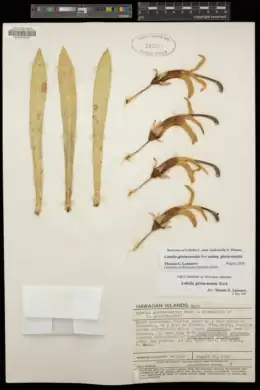 flowering
Lobelia gloria-montis
Campanulaceae · RSA · 1966
Hawaiian Islands
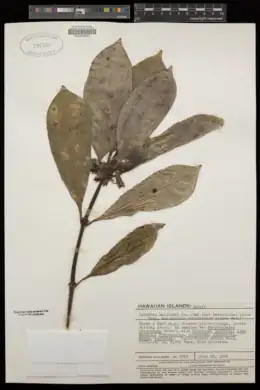 flowering
Labordia baillonii
Loganiaceae · RSA · 1966
Hawaiian Islands
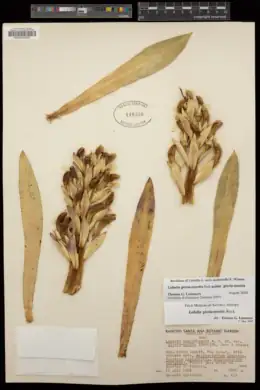 flowering
Lobelia gloria-montis
Campanulaceae · RSA · 1958
Hawaiian Islands
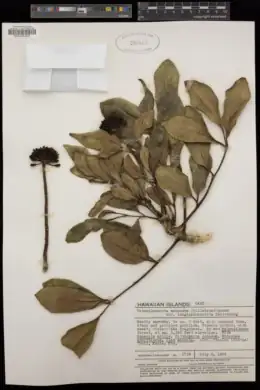 flowering
Tetraplasandra meiandra
Araliaceae · RSA · 1965
Hawaiian Islands
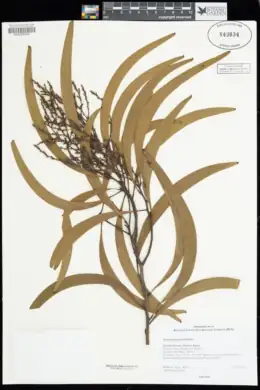 flowering
Acacia koa
Fabaceae · RSA · 1974
Hawaiian Islands
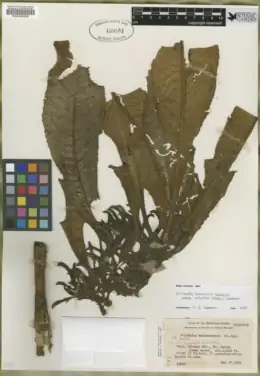 Paratypeflowering
Rollandia lanceolata
Campanulaceae · RSA · 1931
Hawaiian Islands
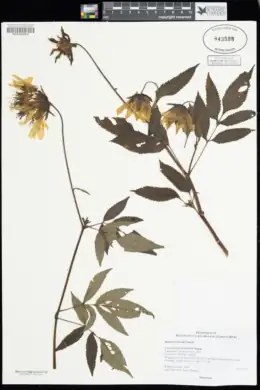 flowering
Bidens cosmoides
Asteraceae · RSA · 1974
Hawaiian Islands
The training set that exists today
controlled-field labels · no OCR, no keyword guess
Every sheet below carries a phenology score a collector wrote into reproductiveCondition — the controlled field, not a guess read off the image. This is what a fruit model would train on, and it already exists in the harvest.
3,879
scored sheets
1,317
carry fruit
171
families
23%
is Fabaceae
By phenophase
- flowering3,038
- fruiting1,317
- budding410
- vegetative57
A sheet can hold several phenophases at once, so these sum past the sheet count. Scored by RSA and MEL.
By family — and the skew to fix
- Fabaceae881
- Asteraceae389
- Brassicaceae224
- Lamiaceae194
- Rosaceae180
- Rutaceae102
- Ericaceae98
- Myrtaceae94
known limitation
The set skews to Fabaceae at 23% of all sheets. A model trained on it as-is would be strongest on the families best represented here — the exact stratification trap the flower-scale work flagged. Only 12 families clear twenty fruiting sheets. Closing that gap is a stated aim, not a hidden flaw: the annotation bench exists to fill the underrepresented families first.
Next head
Fruit and seed presence →