Live · running now, on your click
See it work
Pick a specimen — or paste the address of any specimen photograph from any museum in the world — and watch the software find the parts of it. This is not a recording. It runs when you press the button, on the image you chose, and tells you how long it took.
Pick a specimen
No training, no model, runs anywhere for nothing — and runs on load
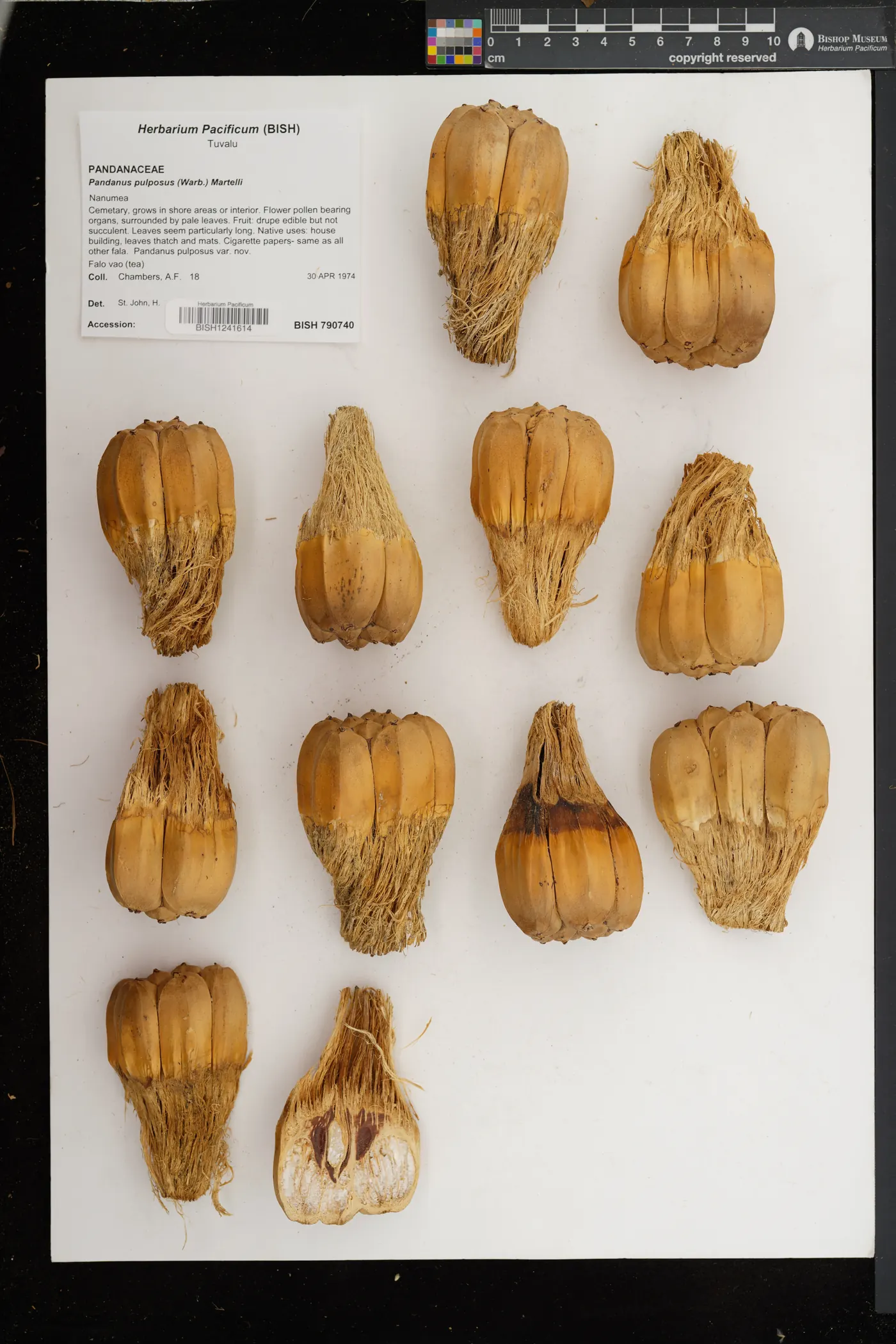
BISH 790740 · Pandanus pulposus (Warb.) Martelli · Tuvalu · 1974
Why this step comes first
Every question anyone wants to ask a specimen — is it in fruit, is the seed ripe, how much leaf did insects eat, what does the label say — depends on first knowing which part of the photograph to look at. A model asked to judge ripeness from a whole sheet spends most of its attention on blank card and a barcode.
So this runs before anything else, and it is the reason the rest is achievable. It also needs no training data at all, which is why it works today on museums this project has never seen.
How it can tell
The colour target
Dried plants and paper are always redder than they are blue. The calibration strip is the only thing on a herbarium sheet that isn't — so it is found by looking for the one place blue or green wins.
The label
Printed text has a fine-grained texture nothing else on the sheet has, and it sits on paper with no colour in it. Brightness alone fails, because on a white mounting card a white label is no brighter than its background.
The plant
Warm in colour, darker than the card, and whatever remains once the paper and the target are accounted for.
The seed packet
As pale and plain as a label, but smooth. Brightness without texture is the whole difference.
What comes next, on top of this
Finding the parts is step one and needs no training. Judging whether fruit is ripe does — which is what the scoring tool and the funded model work are for. The seed packet this parser already locates is where a collection of pressed plants becomes a collection of seeds.