Second data source · field observations
What iNaturalist covers
Herbarium sheets are the deep record and they are thin where it matters. Field observations are the opposite: shallow in time, and not thin at all. This page shows exactly how much of each we have, because a fruiting peak drawn from four records and one drawn from two hundred are different claims.
338,020
research-grade plant observations in Hawaiʻi
Anyone can add one. Identification is confirmed by other users before a record reaches this grade.
16,908
carry a phenology annotation
Someone opened the record and stated what the plant was doing. That is an assertion, not an inference.
4,894
record fruiting
Against 156 fruiting records from every Hawaiian herbarium sheet loaded here.
What is loaded here
1,093 annotated observations across 34 priority invasive species, contributed by 443 different people, every one georeferenced. That is a working sample, not the whole of what is available — the full annotated set for Hawaiian plants is roughly fifteen times larger.
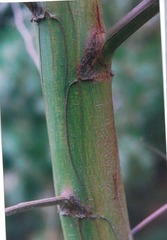 fruiting
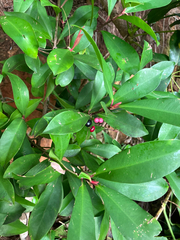 fruiting
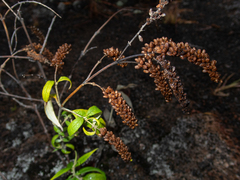 fruiting
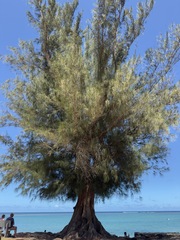 fruiting
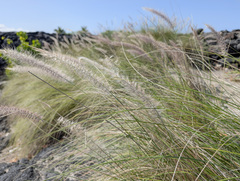 fruiting
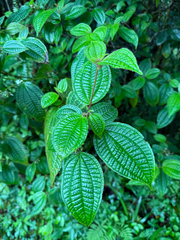 fruiting
Recorded in fruit · Darcy Kehler, Sean Ford, Ocean Fleskes, Dulcey Lima and others, licensed under Creative Commons
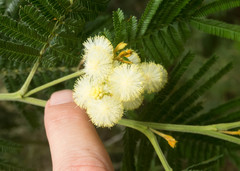 flowering
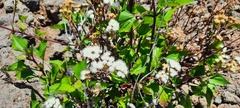 flowering
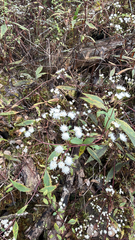 flowering
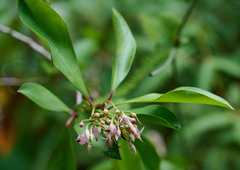 flowering
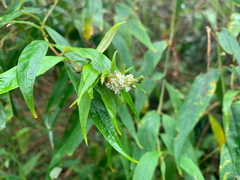 flowering
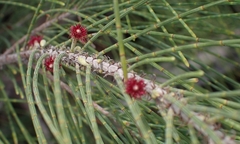 flowering
Recorded in flower · Chris Nelson, Olivier Niederhauser, dfoehring, Tony Iwane and others, licensed under Creative Commons
Roughly a fifth of iNaturalist photographs are all rights reserved and are not shown here at all. What appears is Creative Commons licensed, credited to the photographer, and links back to the original record.
Every observation, by month
all 34 species combined
- fruiting · 436
- flowering · 538
- budding · 151
Where they were made
1,093 plotted










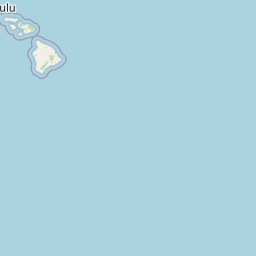








- Oʻahu 147
- Hawaiʻi 128
- Kauaʻi 105
- Maui 100
- Lānaʻi 7
- Molokaʻi 4
Islands are read from the place name attached to each observation, so the counts above are lower than the number of points on the map. Every observation carries coordinates regardless.
Species by species, against the herbarium
ranked by fruiting records
- Schinus terebinthifolius109 observations · 83 observers · 2006–2026 · 5 islands84 fruiting7 herbarium sheets
- Leucaena leucocephala151 observations · 104 observers · 2009–2026 · 4 islands83 fruiting18 herbarium sheets
- Psidium cattleianum104 observations · 68 observers · 2006–2026 · 6 islands64 fruiting8 herbarium sheets
- Ardisia elliptica68 observations · 60 observers · 2002–2026 · 4 islands54 fruiting15 herbarium sheets
- Clidemia hirta70 observations · 52 observers · 2015–2026 · 4 islands27 fruiting3 herbarium sheets
- Casuarina equisetifolia43 observations · 35 observers · 2009–2026 · 4 islands17 fruiting58 herbarium sheets
- Syzygium cumini25 observations · 17 observers · 2007–2026 · 5 islands15 fruiting23 herbarium sheets
- Lantana camara110 observations · 81 observers · 2004–2026 · 6 islands12 fruiting23 herbarium sheets
- Hedychium gardnerianum69 observations · 52 observers · 2006–2026 · 4 islands11 fruiting8 herbarium sheets
- Megathyrsus maximus21 observations · 13 observers · 2006–2026 · 3 islands11 fruiting9 herbarium sheets
- Morella faya9 observations · 7 observers · 2018–2023 · 3 islands7 fruiting20 herbarium sheets
- Cenchrus setaceus13 observations · 9 observers · 2016–2026 · 1 islands7 fruiting22 herbarium sheets
- Rubus argutus25 observations · 21 observers · 2008–2026 · 2 islands6 fruiting21 herbarium sheets
- Buddleja asiatica12 observations · 8 observers · 2016–2026 · 3 islands6 fruiting45 herbarium sheets
- Toona ciliata6 observations · 4 observers · 2022–2025 · 1 islands6 fruiting15 herbarium sheets
- Prosopis pallida35 observations · 20 observers · 2011–2026 · 5 islands5 fruiting9 herbarium sheets
- Passiflora tarminiana21 observations · 19 observers · 1999–2025 · 2 islands4 fruiting13 herbarium sheets
- Pluchea carolinensis35 observations · 24 observers · 2017–2026 · 5 islands4 fruiting33 herbarium sheets
- Rubus ellipticus15 observations · 9 observers · 2018–2026 · 1 islands3 fruiting9 herbarium sheets
- Setaria palmifolia4 observations · 3 observers · 2021–2026 · 2 islands2 fruiting38 herbarium sheets
- Verbesina encelioides37 observations · 31 observers · 2017–2026 · 4 islands2 fruiting47 herbarium sheets
- Acacia mearnsii17 observations · 16 observers · 1999–2025 · 2 islands2 fruiting14 herbarium sheets
- Miconia calvescens5 observations · 5 observers · 2020–2026 · 1 islands1 fruiting6 herbarium sheets
- Tibouchina herbacea11 observations · 10 observers · 2018–2026 · 2 islands1 fruiting4 herbarium sheets
- Ageratina adenophora6 observations · 5 observers · 2016–2023 · 2 islands1 fruiting34 herbarium sheets
- Melinis minutiflora4 observations · 3 observers · 2021–2025 · 1 islands1 fruiting28 herbarium sheets
- Ulex europaeus7 observations · 7 observers · 2008–2022 · 2 islands0 fruiting2 herbarium sheets
- Falcataria moluccana7 observations · 3 observers · 2021–2025 · 2 islands0 fruiting9 herbarium sheets
- Ageratina riparia15 observations · 10 observers · 2019–2026 · 4 islands0 fruiting26 herbarium sheets
- Grevillea robusta19 observations · 15 observers · 2017–2026 · 4 islands0 fruiting21 herbarium sheets
- Erigeron karvinskianus9 observations · 7 observers · 2018–2025 · 2 islands0 fruiting25 herbarium sheets
- Ficus microcarpa9 observations · 4 observers · 2018–2025 · 2 islands0 fruiting17 herbarium sheets
- Andropogon virginicus1 observations · 1 observers · 2026–20260 fruiting21 herbarium sheets
- Paspalum conjugatum1 observations · 1 observers · 2026–20260 fruiting34 herbarium sheets
Why both sources, not one
Observations are dense, current and located to the metre, so they give a calendar for this year. Specimens reach back to the nineteenth century and can be physically re-examined by a specialist, so they are how change over decades is detected. Neither substitutes for the other, and the species pages say which one an answer rests on.
The ceiling they share
iNaturalist records fruiting. It does not record whether the fruit was ripe — its controlled vocabulary has no term for it, exactly as no herbarium field does. So the distinction that decides whether a treatment prevents spread or causes it is missing from both sources, and can only come from looking at the picture.
Which is what the scoring bench is for →